
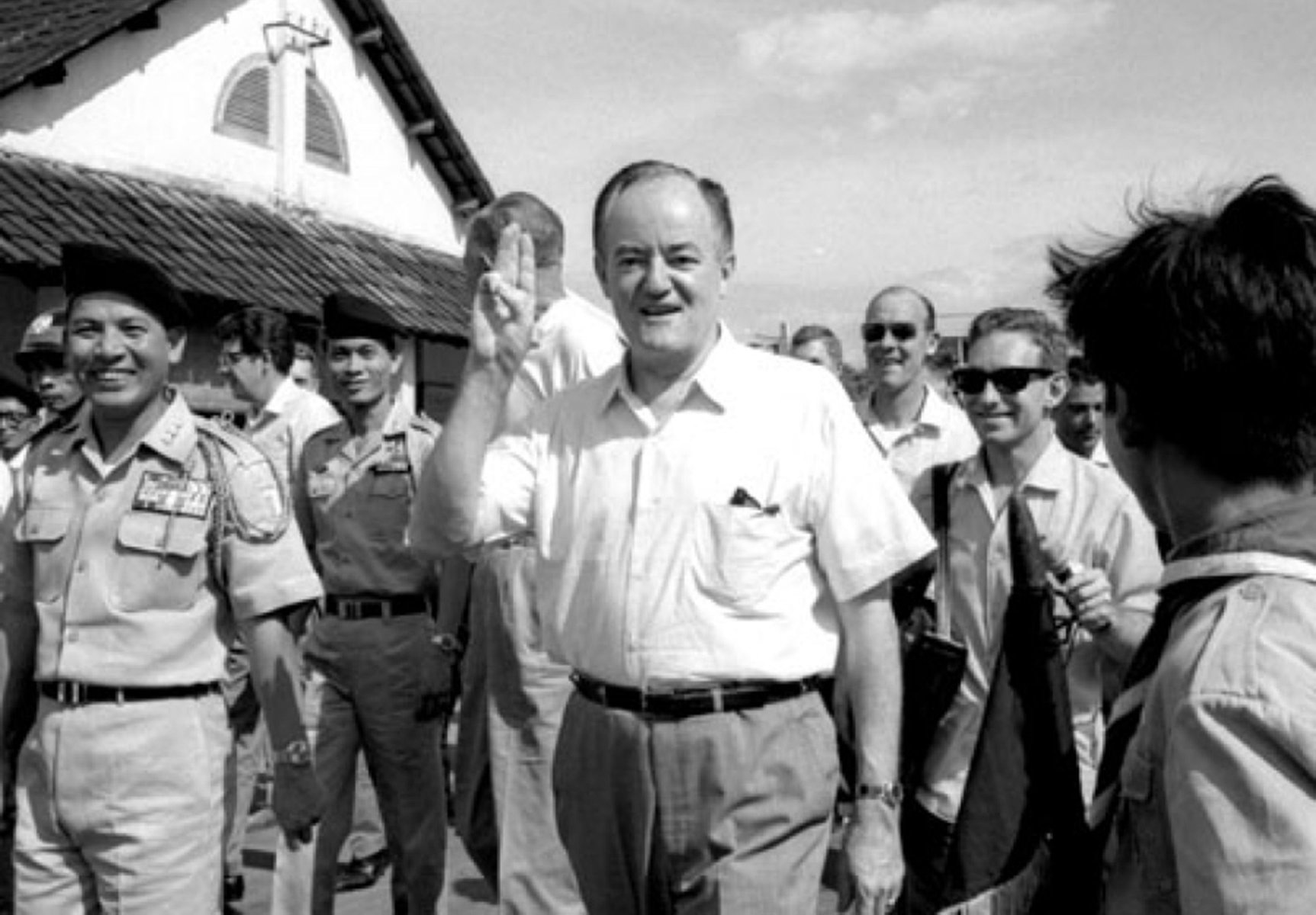
This photograph captures U.S. Vice President Hubert H. Humphrey visiting South Vietnam in mid-February 1966, flanked by South Vietnamese officials and security personnel, including Colonel Phạm Văn Liễu (far left, in uniform).
Key Historical Details
The Event (February 1966 Visit): President Lyndon B. Johnson dispatched Vice President Hubert Humphrey on an extensive diplomatic tour of Asia immediately following the Honolulu Conference in early February 1966. Humphrey's primary mission in South Vietnam was to inspect non-military civic action programs, rural pacification efforts, and nation-building initiatives alongside leaders of the Republic of Vietnam (RVN).
Key Figures Pictured:
Colonel Phạm Văn Liễu (Far Left): Serving at the time as the Director-General of the South Vietnamese National Police (Tổng Giám Đốc Cảnh Sát Quốc Gia). A prominent figure in the Republic of Vietnam Military Forces (ARVN) and a former Marine officer, Col. Liễu was responsible for civil security and anti-infrastructure operations in Saigon and the provinces during this crucial period of the war.
Vice President Hubert H. Humphrey (Center): Shown making a gesture toward nearby onlookers while dressed in civilian attire during a field visit to a local village/community project. The Gesture & Context: In the photo, Humphrey gives a three-finger salute (or scout sign) while acknowledging local Boy Scouts or youth cadres participating in civil defense and community development programs.
Significance
This photo represents the apex of joint U.S.–South Vietnamese efforts to present a unified front emphasizing nation-building, police reform, and internal security during 1966. Shortly after this period, internal political instability—including the Buddhist Uprising in mid-1966—led to major restructuring within the South Vietnamese government and police leadership, resulting in Col. Liễu stepping down from his post as National Police Director.
CIA April 28, 1966 Report on "Prediction of Changes in Government by Colonel Pham Van Lieu"

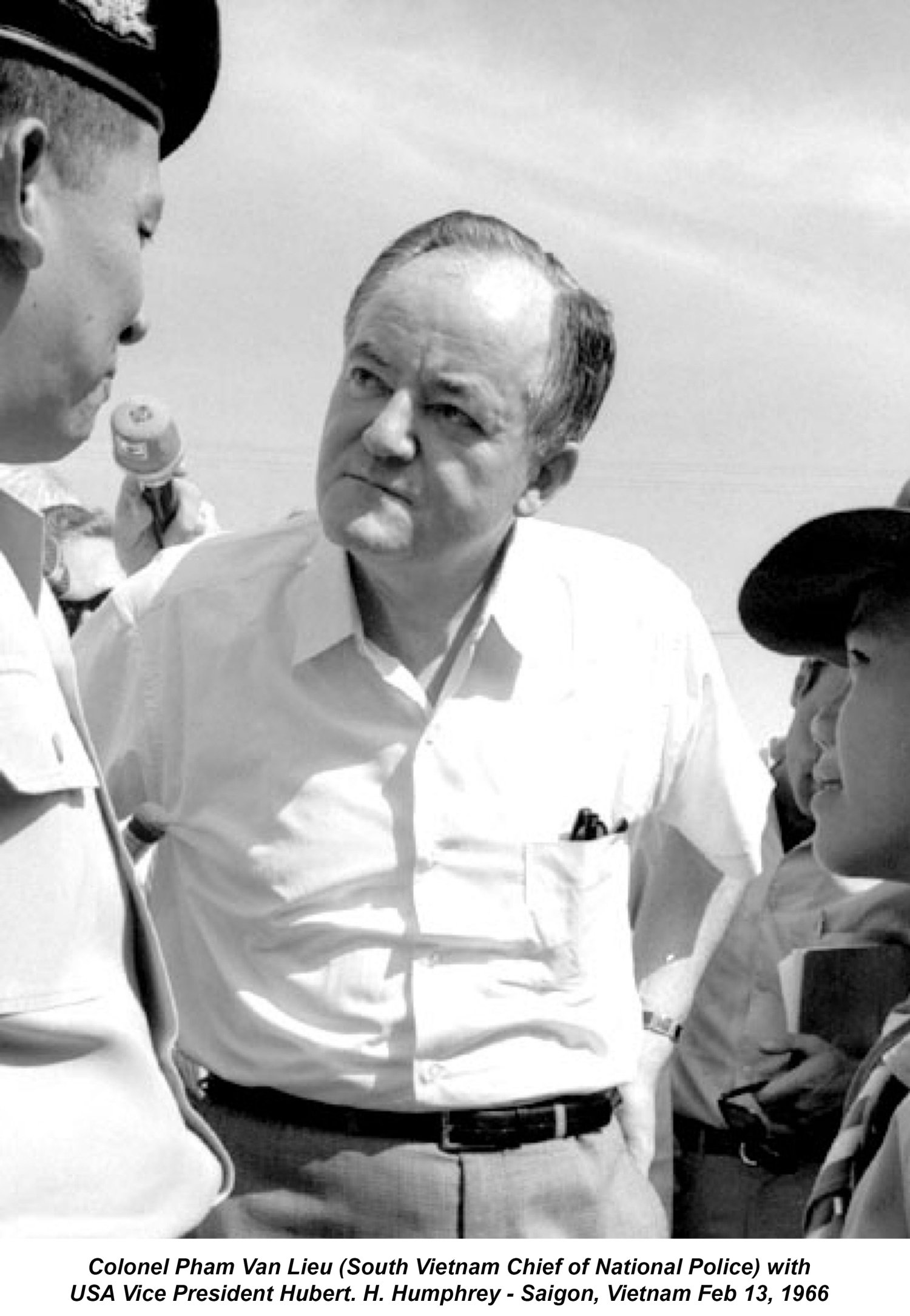
This photograph captures U.S. Vice President Hubert H. Humphrey meeting with Colonel Phạm Văn Liễu, then serving as the Director General of the South Vietnamese National Police, in Saigon on February 13, 1966.
Key Historical Details
Humphrey’s Diplomatic Tour: Vice President Humphrey visited South Vietnam in mid-February 1966 following the Honolulu Conference between U.S. President Lyndon B. Johnson and South Vietnamese leaders Prime Minister Nguyễn Cao Kỳ and Chief of State Nguyễn Văn Thiệu. Humphrey was sent to assess progress on pacification, civil security, and social/economic reform efforts ("the other war").
Col. Phạm Văn Liễu's Leadership: At the time of this meeting, Colonel Liễu held the top leadership post overseeing South Vietnam’s police infrastructure, including urban security, internal intelligence, and counter-insurgency pacification units.
Key Figures Pictured
U.S. Focus on Pacification & Civil Security: The interaction underscores the high priority Washington placed on internal security and civilian policing in early 1966. The U.S. recognized that military operations alone were insufficient without an effective National Police force to secure urban areas and rural villages.
High-Level Political Engagemen: A direct inspection and meeting by the U.S. Vice President demonstrated strong diplomatic backing for the Saigon government's internal security apparatus during a pivotal transition year in the war.
Vietnamese Youth/Civilian Groups:The figure on the far right wearing a neckkerchief is a Vietnamese Boy Scout (Hướng Đạo Việt Nam). During Humphrey’s Saigon walk-throughs and site visits on February 13, 1966, civic and youth organizations were involved alongside police and civil defense forces to showcase community pacification efforts.
Categories: USA VP, Events Tags: USA VP Vietnam, Col. Pham Van Lieu

Janet Ogden
"Great heroism was shown by these men, alongside every service member who fought and those who gave their lives in defense of freedom and democracy in Southeast Asia."
Reply
Pamela Meyer
"Legends in the Vietnam Conflict, these men are true heroes of the Vietnam War—honoring all who served, fought, and gave the ultimate sacrifice for the cause of freedom and democracy in Southeast Asia."
Reply
Chintana Patel
Great people of the Vietnam War.
Reply
Jean Doe
In the Vietnam War - South Korea, Australia, and U.S.A. provided troops (boots on the ground) in Vietnam.
Reply
Ben Afflick
USA - 58,220 Fatalities - Includes 47,434 combat/hostile deaths and 10,786 non-hostile deaths according to the U.S. Defense Casualty Analysis System (DCAS).
South Korea - 5,099 Fatalities - South Korea deployed over 300,000 personnel, representing the largest foreign contingent assisting South Vietnam and the U.S..
Australia - 521 Fatalities - Represents casualties among the ~60,000 Australian service personnel deployed between 1962 and 1975.
Reply
Jean Barry
An estimated 130,000 to 141,000 refugees left South Vietnam during the initial exodus in 1975, which coincided with the collapse of the South Vietnamese government and the Fall of Saigon.
Reply